Intermittent Fasting
Eat within a window — most commonly eight hours — and let the body rest the other sixteen. The most popular eating pattern of the decade, and one that Muslim women already know in their bones: it is Ramadan, minus the spiritual obligation, repeated on ordinary days.


Older than every diet book
Fasting is not new. Every major faith has practised it for millennia — and for Muslims, a month of dawn-to-dusk fasting is one of the five pillars of Islam. What's new is the secular, year-round packaging: "intermittent fasting," popularised in the 2010s by writers and researchers who noticed that when you eat affects the body almost as much as what.
The most common form is 16:8 — a daily sixteen-hour fast and an eight-hour eating window. Others fast two days a week (5:2) or alternate days. The principle is the same: compress eating, lengthen the overnight rest, and let insulin fall between meals.
For our clients there's a quiet advantage: you have likely fasted every Ramadan of your adult life. The discipline is already there. We're simply borrowing the rhythm — gently, and never where it doesn't belong.
"You already know how to do this. Ramadan proves it every year. Intermittent fasting just asks: what if a gentler version of that rhythm became ordinary?"The familiar made everyday
Promising — and honestly mixed
Fasting is genuinely useful for some things and over-hyped for others. Here's the straight version.
Blood sugar & insulin
Even without weight loss, eating earlier in the day improved insulin sensitivity and blood-pressure markers — evidence that timing itself matters, not only calories.
Weight loss — the null result
A well-run trial found 16:8 produced no significant extra weight loss versus normal meals over 12 weeks. The lesson: fasting only helps weight if it actually makes you eat less.
As good as calorie-counting
Across studies, intermittent fasting produces weight loss comparable to daily calorie restriction — not magically better, but for many people easier to stick to.
"Autophagy" & longevity
The dramatic anti-ageing and "autophagy" claims you see online come largely from animal studies. The human longevity case is plausible and interesting — but not yet proven. We won't oversell it.
Three things the window does
Fewer hours, fewer calories
For most people, an eight-hour window simply removes late-night grazing and mindless snacking. Much of the benefit is that quiet, automatic calorie cut — no counting required.
Insulin gets a rest
Long gaps between meals let insulin fall and stay low. For insulin resistance and early type-2 diabetes, those rest periods can meaningfully improve control.
It works with your clock
Eating earlier and stopping before bed aligns food with your circadian rhythm — which appears to help blood sugar, sleep and digestion more than eating late.
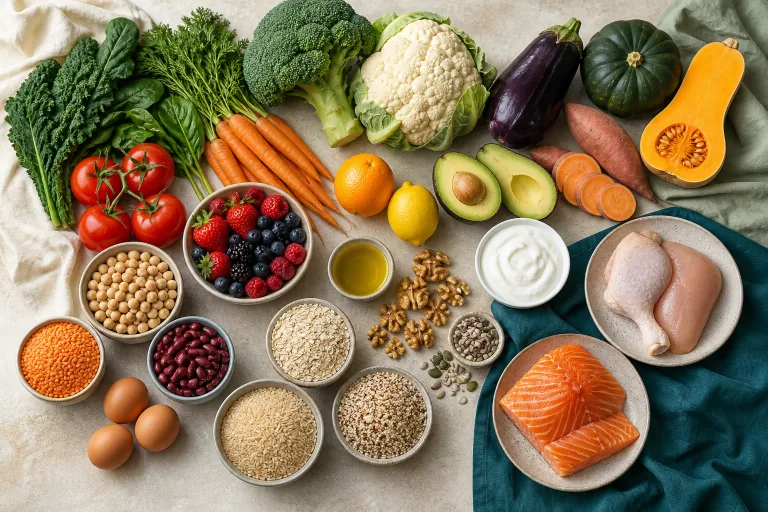
What to eat — and what keeps the fast
Fasting is about timing, but the window still has to be real food, or it doesn't work.
A 16:8 day, real life
A common window is noon to 8pm — but we set yours around family meals and prayer.
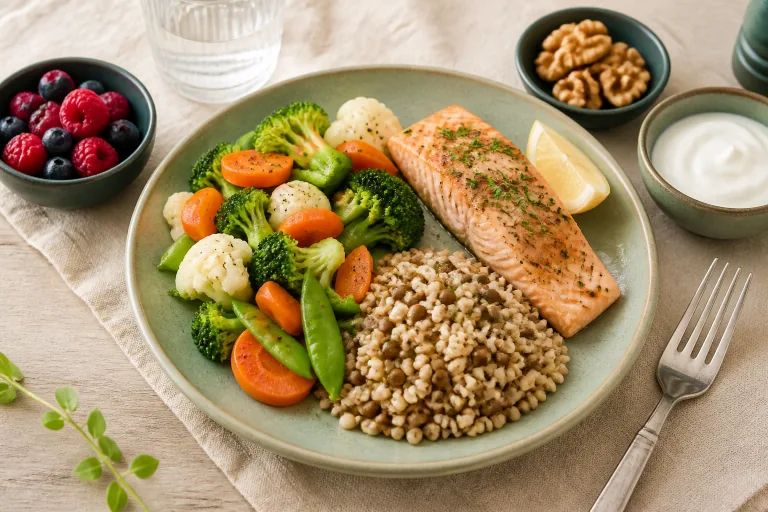
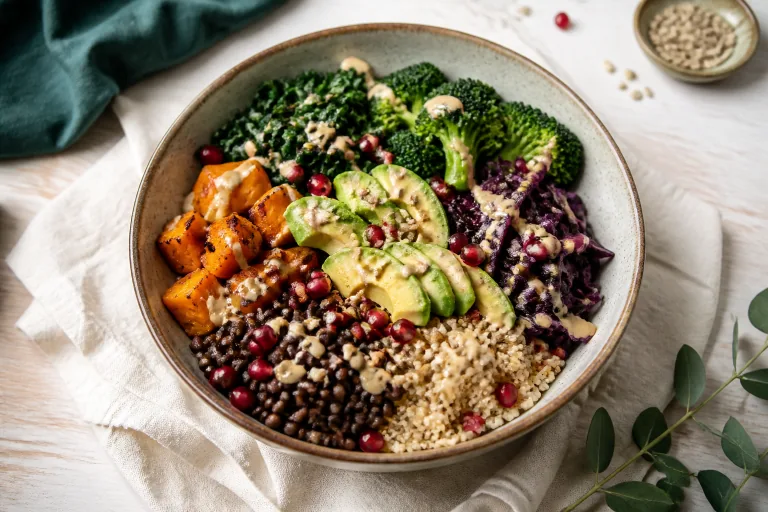
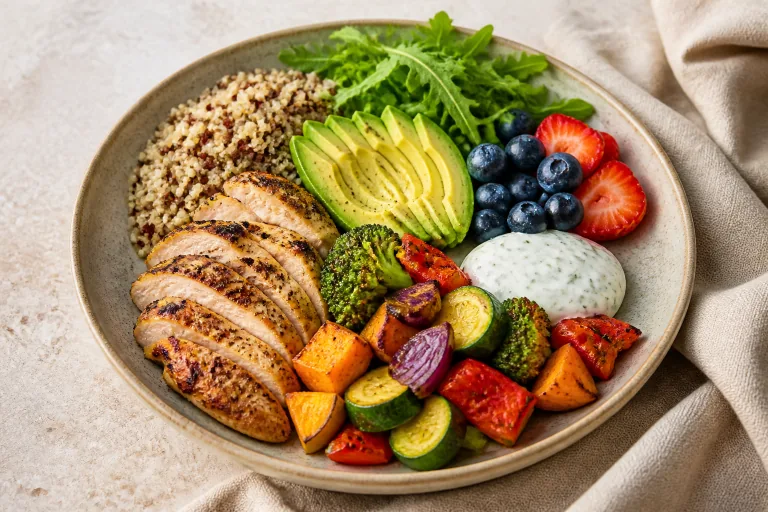
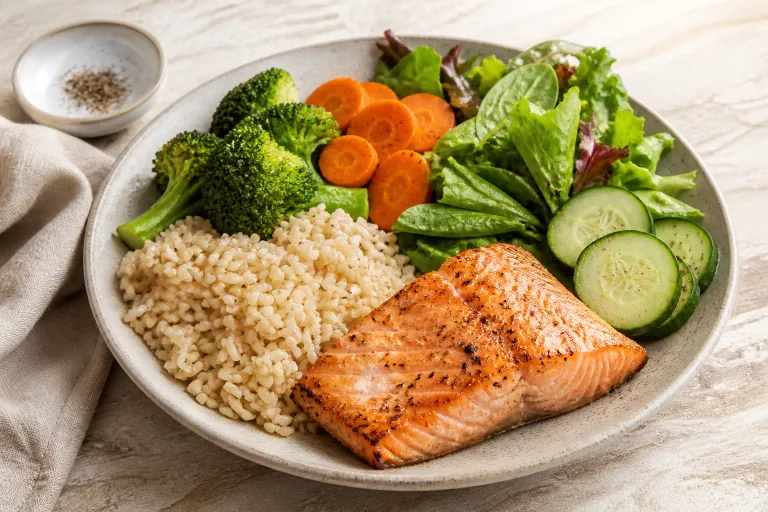
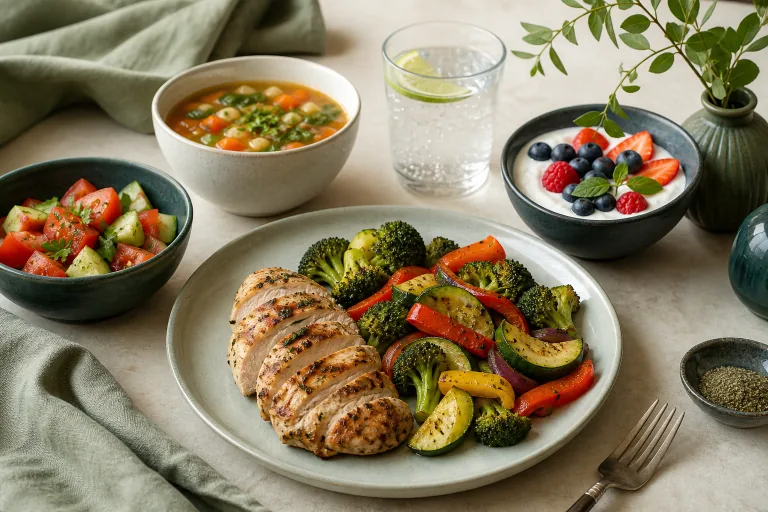
Four window-friendly recipes
Built to refuel without spiking blood sugar. Maryam tailors the window to your schedule.

Who this is for
A fit if you…
- Already skip breakfast comfortably, or fast easily in Ramadan
- Want simple structure without weighing food or counting calories
- Have insulin resistance, PCOS or early blood-sugar issues
- Snack late at night and know it's the problem
Not for you if you…
- Are pregnant or breastfeeding
- Have any history of disordered eating (fasting can re-trigger it)
- Take insulin or sulfonylureas without medical supervision
- Are a child, teen, or significantly underweight
The rhythm is the start. You are the rest.
A window is just a clock. We build the life around it.
We set your window
Around your family's meals, your prayer times, your work and your sleep — not a generic noon-to-eight. The best window is the one you'll actually keep.
We use Ramadan as training
You already fast a month a year. We build on that muscle memory and make sure your suhoor and iftar are nourishing, not a fried-food free-for-all.
We protect your health
If you're on medication, pregnant, or have a complicated history, we adapt or steer you elsewhere. Fasting should never cost you more than it gives.
The honest answers
In rhythm, yes — and that's the advantage. The big difference: Ramadan also restricts water during daylight and is a spiritual act, while secular 16:8 lets you drink water freely and is purely about metabolism. We treat your Ramadan fasting as the spiritual priority and use the everyday version only as a health tool the rest of the year.
Black tea or coffee — yes, they don't break the fast. The moment you add milk or sugar, even a little, it's calories, and the fast is over. Save your proper doodh patti for inside the window.
Not if you eat enough protein in your window and stay active. We make protein the anchor of every window meal precisely to protect muscle while you lose fat.
For most healthy adults, a daily 16:8 rhythm appears safe long-term. It is not for pregnancy, breastfeeding, or anyone with a history of disordered eating — and on diabetes medication it needs supervision. We screen for all of this first.
It can help the insulin resistance behind many PCOS cases, and pairs well with a low-GI diet. But for some women aggressive fasting worsens cycles and stress — so we start gently and watch how your body responds. See the PCOS Protocol.
Light to moderate exercise fasted is fine for most and many enjoy it. For heavy training, we usually place your workout near the start of your eating window so you can refuel. We tailor this to your routine.
Where this comes from
- Crossover trialTiming & metabolism. Sutton EF, et al. Early Time-Restricted Feeding Improves Insulin Sensitivity, Blood Pressure… Cell Metabolism 2018;27:1212–1221. Sutton 2018 (Cell Metab) ↗
- Randomized trialThe null result. Lowe DA, et al. Effects of Time-Restricted Eating on Weight Loss… (TREAT). JAMA Intern Med 2020;180:1491–1499. Lowe 2020 (JAMA IM, TREAT) ↗
- ReviewMechanisms & evidence. de Cabo R, Mattson MP. Effects of Intermittent Fasting on Health, Aging, and Disease. N Engl J Med 2019;381:2541–2551. de Cabo 2019 (NEJM) ↗
- Meta-analysesvs calorie restriction. Pooled trials finding intermittent fasting broadly comparable to continuous energy restriction for weight. Cioffi 2018 (J Transl Med) ↗
- TraditionFasting in Islam. Sawm (Ramadan) — one of the Five Pillars; the dawn-to-dusk rhythm this diet secularizes.
Compiled by Nidari Nutrition, June 2026. Pending formal clinical review by Maryam Shabbir, DN. Educational reference — not a substitute for individual medical advice. Do not fast on diabetes medication, in pregnancy, or with an eating-disorder history without professional guidance.
Ready to discuss fasting?
Fifteen minutes with a dietitian. We'll find the window that fits your life and your faith — or tell you honestly if fasting isn't the right tool for you right now.